Eye of Horus
An ancient mark of protection, restoration, and awakened sight.
The Piece
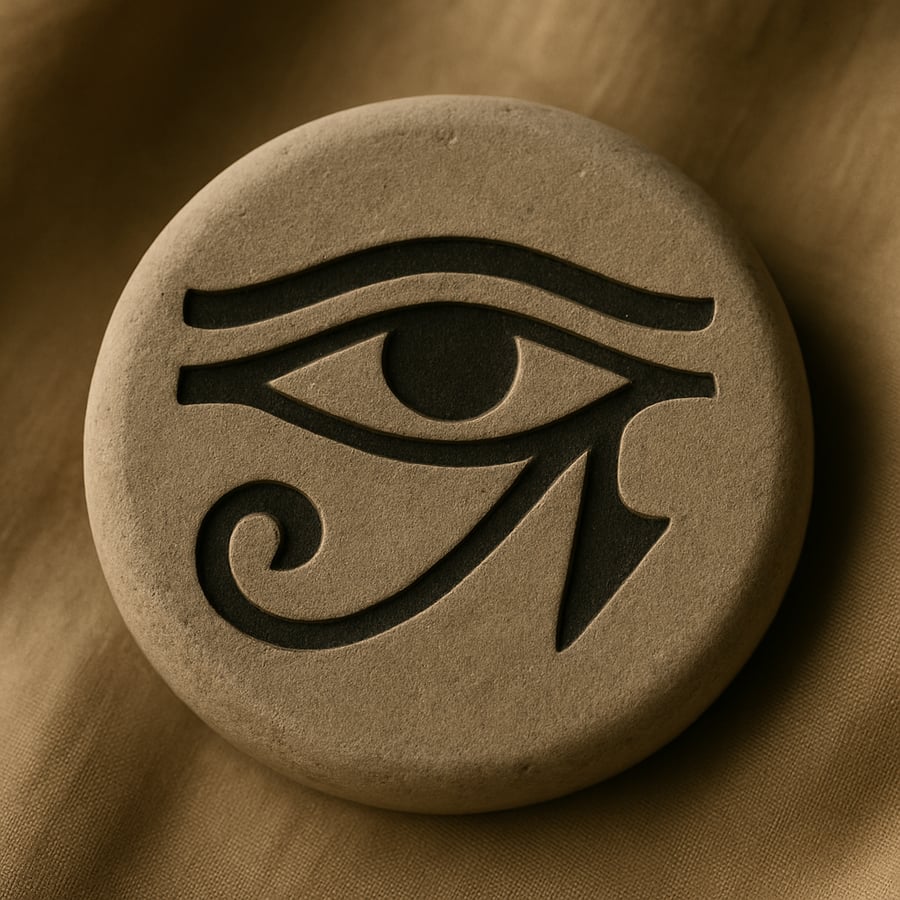
This piece was formed in stone and brought into clarity in the Forge of Elaryn.
The Eye of Horus was engraved within a circular field, its flowing lines carefully balanced to preserve the distinctive form of the ancient symbol. The curves of the brow, the central eye, and the descending spiral create a sense of watchfulness within the stone.
The surface around the symbol remains calm and unadorned, allowing the eye itself to hold the centre of attention.
Its presence is steady and composed, giving the impression of a symbol that quietly observes rather than demands attention.
The Symbol
The Eye of Horus, also known as the Wedjat, is one of the most recognisable symbols of ancient Egypt.
It represents protection, healing, and restored balance. In Egyptian mythology the eye belonged to the god Horus and was said to have been damaged in a cosmic struggle before being restored — making it a symbol of renewal and wholeness.
Because of this story the Eye of Horus became associated with protection and safeguarding. It was often placed on amulets, temples, and vessels as a sign of watchful presence.
Beyond protection, the symbol also represents perception and awareness — the ability to see clearly and remain attentive to what lies beneath appearances.
Within the Forge the Eye of Horus represents awakened sight: a reminder to observe carefully, remain aware, and recognise the deeper patterns that shape the world.
Status
In the Forge
The piece began with the circular boundary of the stone, establishing a calm field for the symbol.
The central eye was engraved first to define the focal point. From there the surrounding lines were shaped outward — the brow line, the trailing curve, and the spiral that completes the form.
The engraving was kept deliberate and restrained so the symbol would remain clear without becoming heavy.
As light moves across the surface, the carved lines create subtle contrasts of shadow, allowing the ancient form to emerge quietly from the material.